


Distance: 2km or about 1.5 miles
Sheffield grew from a small medieval settlement into an industrial powerhouse, famed for steel production. By the 19th century, it was a global leader in cutlery and steel-making, pioneering stainless steel in 1913. The city’s industry declined in the late 20th century, but regeneration efforts revitalized it with a focus on education, culture, and advanced manufacturing. It’s home to two universities, Sheffield is known for its green spaces, music scene, and sporting heritage. Today, it blends industrial history with modern innovation, making it one of the UK’s most dynamic cities.
Lets start our trip around Kelham Island which is associated with the steel industry and our first pub is.
You can download the walk here – https://www.bar-trek.com/crawl/711
1. The Harlequin
108 Nursery St, Sheffield S3 8GG
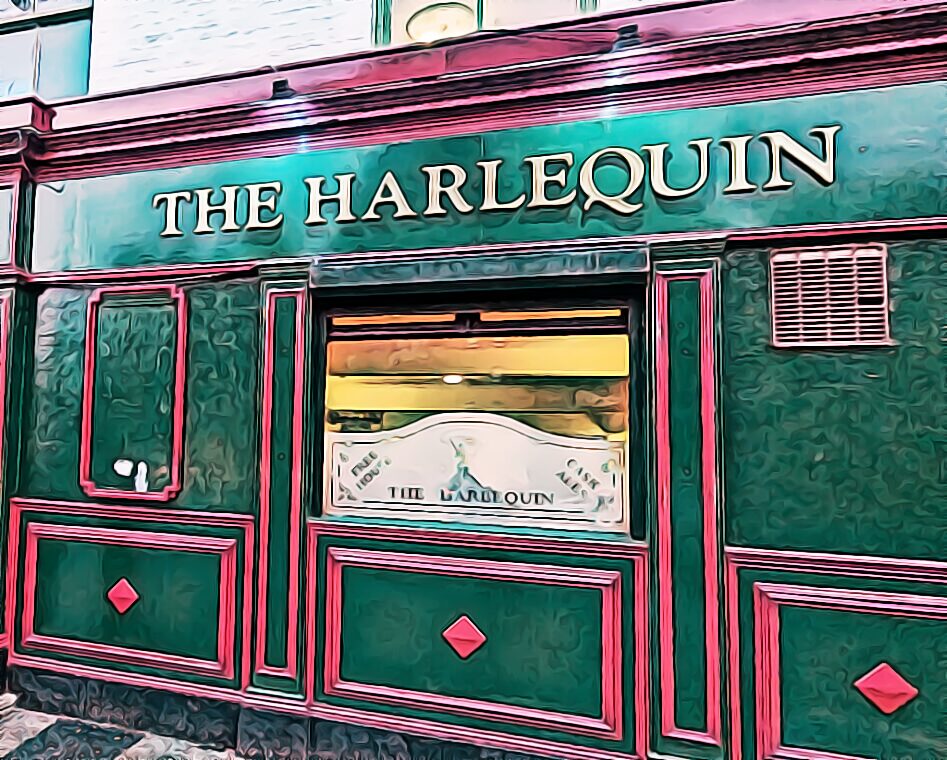
The Harlequin Pub in Sheffield began as the Manchester, Lincoln and Sheffield Railway Hotel in 1845, serving passengers of the nearby railway terminus. In 2006, publican Wendy Woodhouse revitalized the then-closed establishment, renaming it The Harlequin after a demolished local pub she had tried to save. In 2024, new landlords Chris Bamford and Kate Major took over, emphasizing inclusivity and community. Today, The Harlequin continues to be a cherished part of Sheffield’s pub scene.
It is a fairly big L-shape pub, recently reopened following refurbishment under the same management as the Rutland Arms and Crow Inn. The bar features 7 varied cask ales plus cider along with an interesting range of craft beers on keg. An ethos of only stocking independent producers where possible applies to all the beers, wines and spirits! The lower area at the back of the pub features a dartboard and there is a small outdoor drinking area at the rear.
Exit and turn left down Nursery Street to the New Testament Church of God. This is a Grade II listed building designed by Flockton, Lee & Flockton, stands on Nursery Street. Financed by Anne and Elizabeth Harrison, this church is an exact replica of Christ Church in Attercliffe, showcasing historical architectural design.
Nursery Street in Sheffield has a rich history, evolving from verdant landscapes to a hub of industrial and community significance. In the early 20th century, the street was home to the Coroner’s Court and Mortuary, established in 1913-1914.
This building witnessed numerous inquests until the 1970s when operations moved to the Medico Legal Centre in Netherthorpe. Subsequently, the premises served various purposes, including housing Sheffield City Council’s Employment Department and later functioning as the Old Coroner’s Court Business Centre. Despite its historical importance, the building faced neglect and was eventually slated for demolition to make way for new developments.
Now backtrack past the Harlequin and continue crossing over the A61. On the island between the two carriageways sits an iron bridge on your left.
Originally constructed as a wooden bridge around 1726, it provided a crucial link to the old road leading to Leeds and Barnsley via Pitsmoor. In 1795, it was replaced by one of the earliest iron bridges, crafted by Samuel Walker, a Rotherham ironmaster, just 15 years after the famed Iron Bridge at Coalbrookdale. This structure was swept away in 1864 and subsequently replaced by a new iron bridge built at the Milton Ironworks near Elsecar.
Partially rebuilt in 1921, the bridge’s iron balustrade bears the inscription “J Butler & Co Ltd, Stanningley Ironworks, Leeds 1921.” While its original function has been superseded by Borough Bridge due to industrial developments, the Iron Bridge remains in place, also serving to carry a large water main over the River Don. Recently, a ‘Friends Group’ has undertaken efforts to preserve and enhance the bridge, including various ‘street art’ installations that highlight its historical significance.
Now head across the second section of the A61 to our next pub.
2. Riverside Kelham
1 Mowbray St, Neepsend, Sheffield S3 8EN
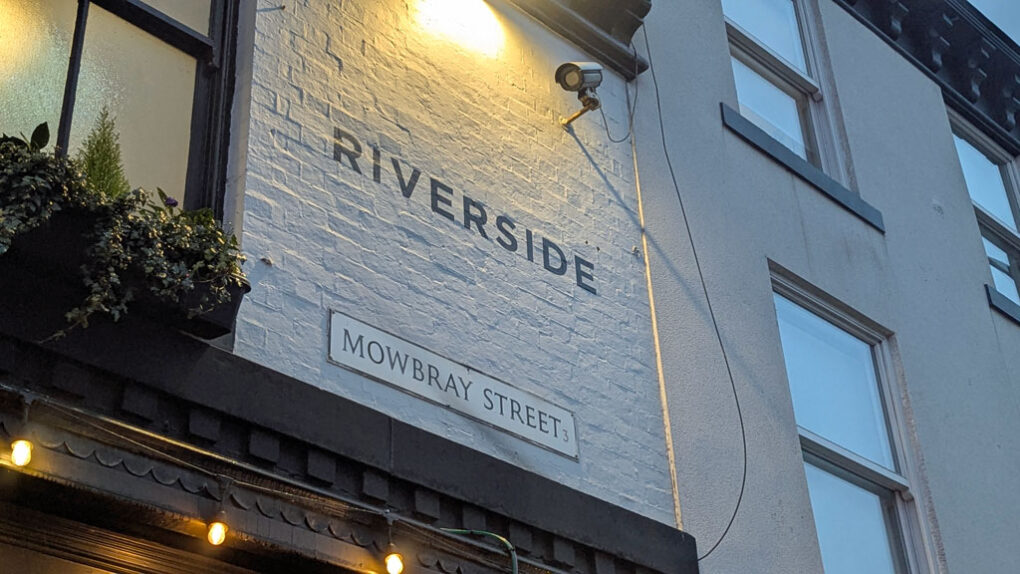
This pub is owned by True North Brewery and they serve two changing house beers from their own brewery and are complemented by two changing guest ales, mostly from local breweries, like Abbeydale and Acorn. It was originally a residential hotel, the building became the Brown Cow pub when the servants’ quarters were turned into a beer cellar. The pub has been called the Riverside since 1995. There were three ‘Ward’s’ pubs in a row from the ‘Brown Cow’, now the Riverside, (Mowbray Street) along with the old Manchester Hotel, now the Harlequin, (Nursery Street) a few yards away and the old ‘Harlequin’ which stood at 26 Johnson Street around the next corner. If the sun is shining then sit outside on the terrace overlooking the River Don. One of the five rivers which meet at the confluence where the village of Sheffield first developed.
When leaving backtrack to the A61 and cross over the River Don and take the riverside path on your right which is part of the Upper Don Trail. Follow this round into Kelham Square and straight ahead onto Kelham Island.
Kelham Island, a man-made island in Sheffield, was created in the 12th century by constructing a mill race to divert water from the River Don for a corn mill owned by the Lord of the Manor. In 1829, John Crowley established an iron foundry on the site, which operated until the 1890s. This was followed by the construction of a power station in 1899 to supply electricity for Sheffield’s trams, remaining in use until the 1930s. The building then served various purposes until its transformation into the Kelham Island Museum in 1982, dedicated to preserving Sheffield’s industrial heritage.
The museum is well worth a vist and our pub is location within its grounds.
3. The Millowners Arms
Alma St, Sheffield S3 8RY
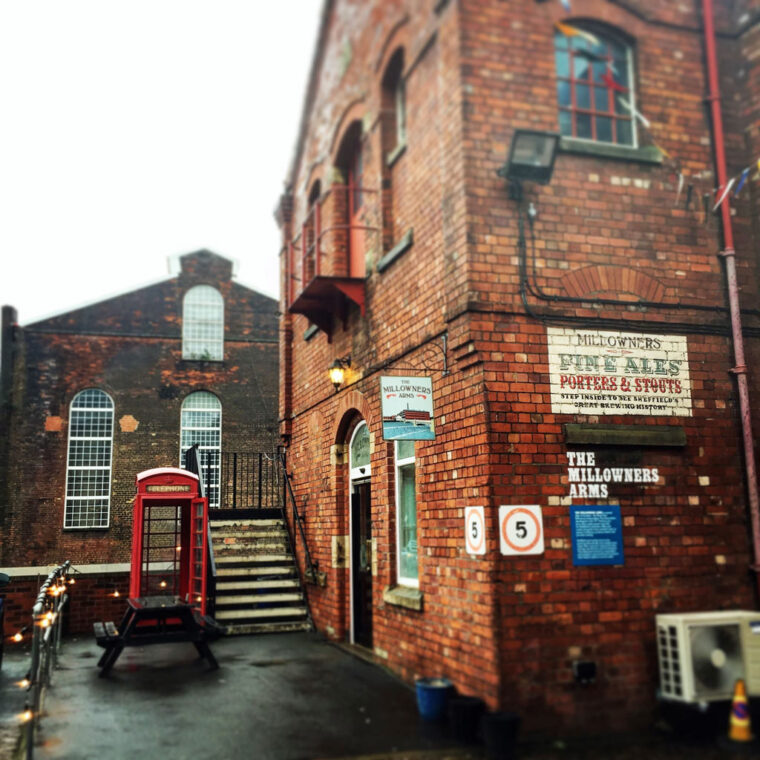
The was formerly a museum exhibit celebrating Sheffield’s pub and brewing history, but now the traditional pub room is now open full time as a public bar with real ale and other craft beers available along with a simple food menu. It is operated by the same local independent business as the museum cafe and offers Six real ales along with other beers on keg. The existing cast iron circular roof support columns remain and have been incorporated into the design. As part of the construction MWS Joinery Ltd built in an original C17th. stone fireplace, taken from the defunct Travellers pub (Wadsley Bridge).
The design is of a typical old pub as decorated in the 1970’s, even down to the reclaimed telephone box outside and the nicotine stained walls. It also includes a ‘sheffield’ dartboard. The doors and windows have been acid etched with the pub name, the bar has been made to measure complete with glass shelves and reclaimed beer pumps, period radiators and light fittings.
Now head back out the way you came. In front of you there is the old mill race or run. Kelham Island isn’t really an island but a man-made spit of land resulting from the construction of the mill race in the 12th century. The mill race or ‘goit’ diverted water from the River Don to power a corn mill situated at Millsands near Lady’s Bridge that belonged to the Lord of the Manor. Apparently the island was named after the Town Armourer, Kellam Homer, who set up a grinding workshop in 1637.
Some water still flows in to the goit and you can see the nine pillars or footings of the Britannia Corn Mill which sat astride the goit. The buildings were demolished in 1975. From here the goit is culverted running beneath Alma Street with the outfall on Nursery Street.
Turn left at the exit of the museum and head back along the road. Follow it round to the right and our next pub.
4. The Fat Cat
23 Alma St, Sheffield S3 8SA
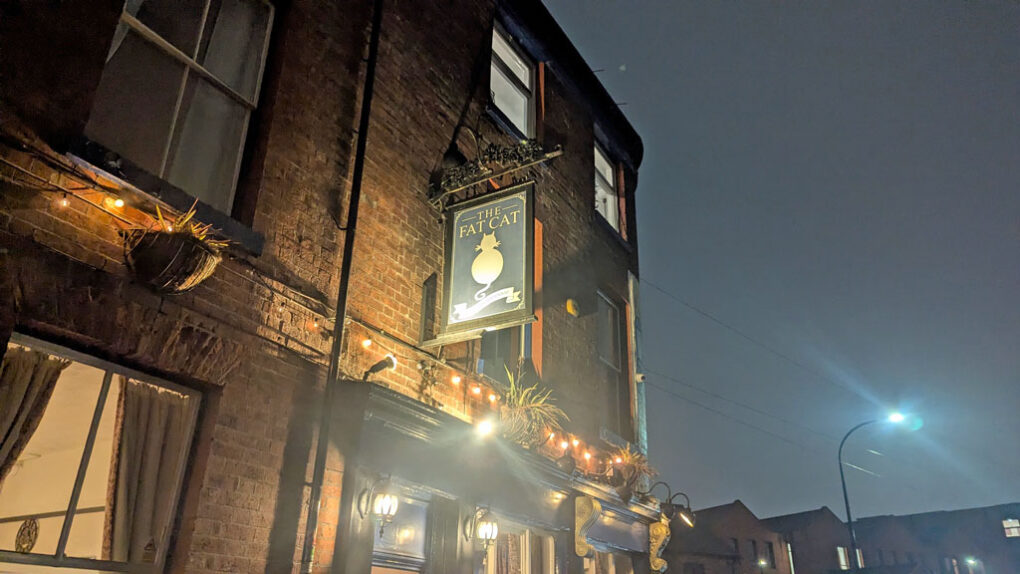
The Fat Cat, located in Sheffield’s Kelham Island district, opened in 1981 and is renowned as the city’s first real ale pub. It has gained national recognition for its quality real ales, traditional pub atmosphere, and industrial setting. Cask beers from around the country, including occasionally Kelham Island Pale Rider brewed by Thornbridge. The walls are covered with many awards presented to the pub and Kelham Island brewery. In June 2018, local artist Matt Cockayne, spend three days painting a mural on the outside corner wall.
Turn right when leaving the pub and head down Alma Street. Turn into Russell Street and our next stop.
5 . The Kelham Island Tavern
62 Russell St, Sheffield S3 8RW
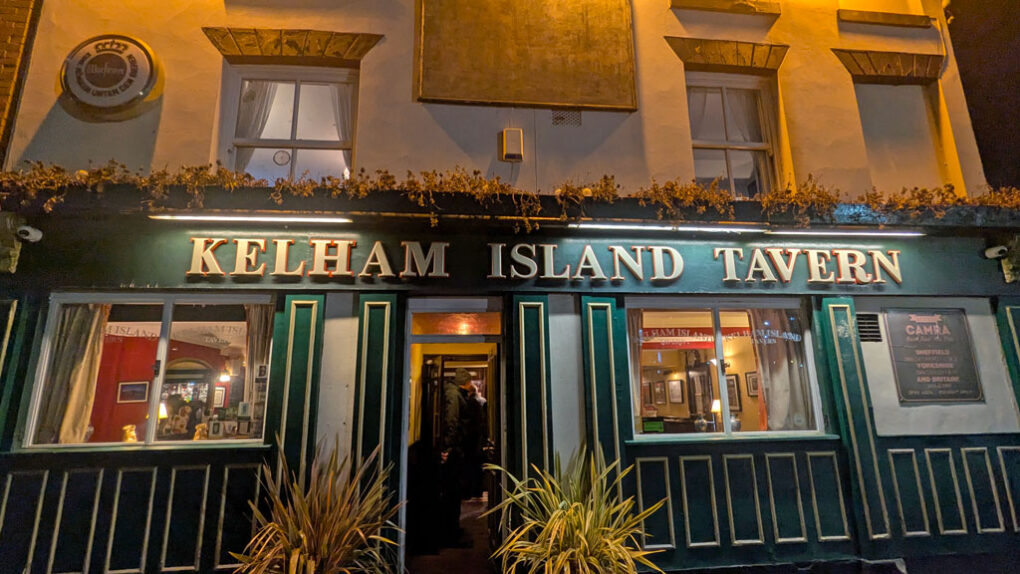
The Kelham Island Tavern, located at 62 Russell Street in Sheffield’s historic Kelham Island district, has a storied history dating back to the 1830s. Originally constructed as part of a terrace, it began as “The Sawmaker” and was later renamed the “White Hart.” In the early 1990s, it first adopted the name “Kelham Island Tavern” but soon after ceased operations, leaving the building derelict.
In 2002, the pub was revitalized and reopened under the same name, focusing on real ales and creating a welcoming atmosphere. Its commitment to quality and community quickly garnered attention, and by 2003, it was recognized as one of the top real ale pubs in Yorkshire. Despite facing challenges, such as significant damage during the 2007 Sheffield floods, the tavern demonstrated resilience, closing for only five weeks for refurbishment before resuming service. The Kelham Island Tavern has achieved numerous accolades, including being the first pub to win the Campaign for Real Ale (CAMRA) National Pub of the Year award in consecutive years, 2008 and 2009. It has also secured the Sheffield Pub of the Year title multiple times, with its 17th win in 2024, a record-breaking achievement. Today, the tavern remains a cornerstone of Sheffield’s vibrant pub scene, celebrated for its exceptional real ales, traditional folk music sessions, and a charming beer garden adorned with palm trees.
Now turn right back down Russell Street and straight across the junction into Green Lane. Follow this road to our next pub.
6. SALT
Green Ln, Sheffield S3 8SE
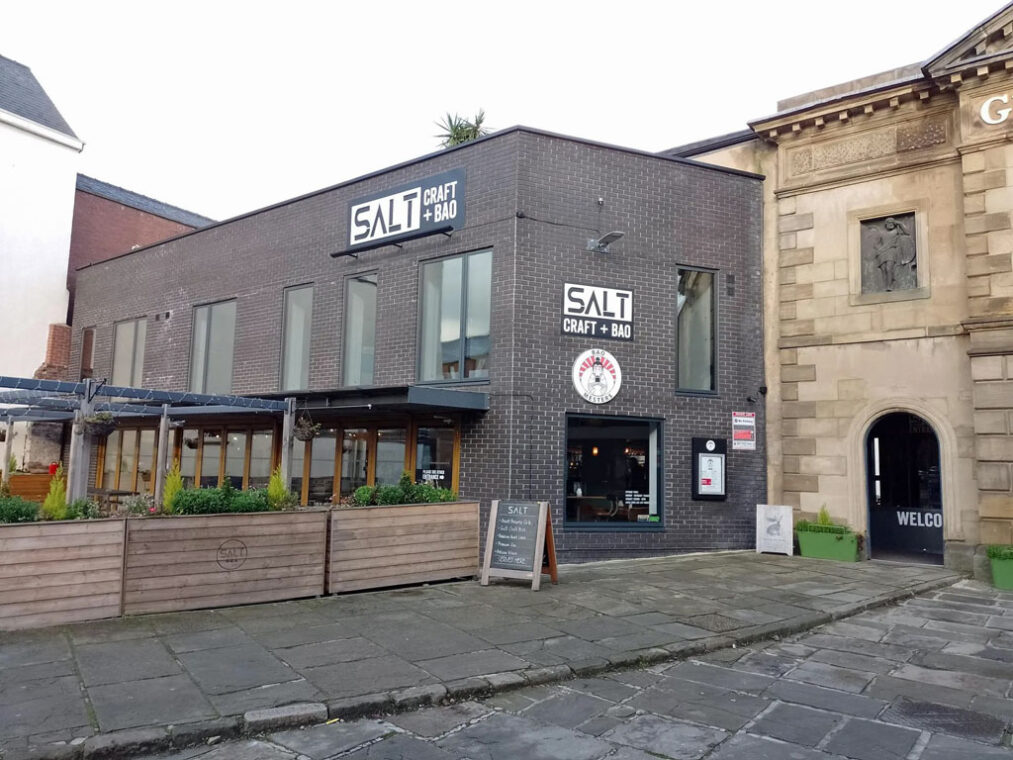
Before you head inside take a look at the old Green Lane Works and the ornate entrance. Established in 1795, it became renowned for producing ornamental stove grates and fenders, earning international accolades in the mid-19th century. Look up at the entrance archway, this was constructed in 1860 and is now a Grade-II listed structure. This archway, possibly designed by sculptor Alfred Stevens, showcases intricate bronze plaques depicting Greek deities Hephaestus and Athena.
This pub is part of the SALT pub group, in turn owned by Ossett Brewery. Since it’s days as Stew and Oyster, the bar has been moved to the back and rotated by ninety degrees giving plenty more room inside. Four handpulls adorn the bar, usually with two beers from Ossett and associated breweries and two guests. Now exit SALT and back to Green Lane turning right following the road to is end.
As you walk you will see on your right side the remains of Brooklyn Works, the facility was originally established for Alfred Beckett & Sons, a firm specializing in the manufacture of steel, saws, and files. It was significantly damaged in the Great Sheffield Flood of 1864. Alfred Beckett & Sons maintained production at Brooklyn Works until the mid-1960s, utilizing the “Matchless” trademark for their products. In 1967, the company was acquired by the Tempered Spring Company Ltd of Sheffield, after which the building stood vacant for a period. Recognizing its historical significance, Brooklyn Works was designated a Grade II listed building in November 1985, ensuring its preservation. During the 1990s, the site underwent a transformation led by AXIS Architecture, converting the former industrial space into residential apartments and offices.
The next building we pass is the old Wharncliffe Works, built around 1861 for Steel & Garland, manufacturers of stoves, grates and fenders. At some stage it is believed that Bowie knives were once made here and rumour has it that a knife called the Wharncliffe Whitler gained its name from these premises.
At the end of Green Lane cross over the A61 to our next pub.
7. The Wellington
1 Henry St, Sheffield S3 7EQ
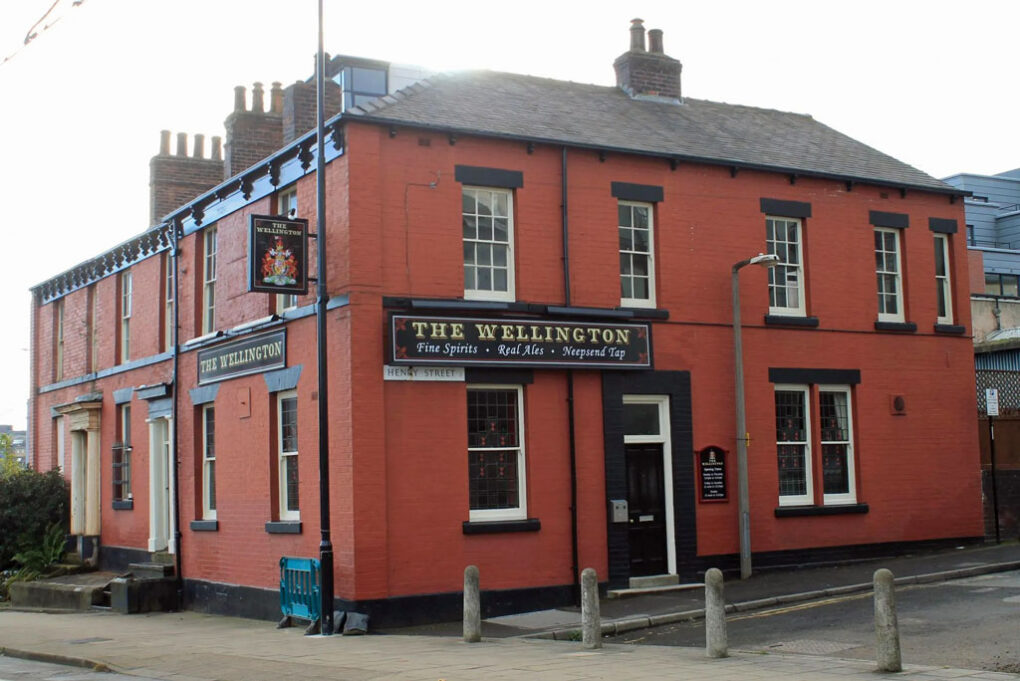
The Wellington Pub has a rich history dating back to its construction in 1839. In 1940, the pub underwent a significant refurbishment, adopting an Art Deco style that remains evident in its interior today. This three-roomed layout includes a lobby bar with terrazzo flooring and a ply-panelled bar counter, reflecting the 1940s design. For many years, The Wellington was owned by Tennant Brothers Ltd. In 1993, it became a free house under the ownership of Neil and Sheila Clarke, who renamed it the ‘Cask and Cutler’ and established the Port Mahon Brewery on-site. The brewery later operated under the name Little Ale Cart Brewing.
In 2005, Richard Appleton took over the pub, restoring its original name, ‘The Wellington.’ In 2016, the pub became part of the Sheaf Inns chain, which also includes The Blake and The Sheaf View. The Wellington is renowned for its traditional, cosy atmosphere and a selection of real ales, including beers from the Neepsend Brewery. It has been recognized for its historic interior and continues to be a cherished establishment in Sheffield’s pub scene.
Turn right when leaving the pub and follow the tram tracks back to Shalesmoor tram stop. Cross the tracks and then across the roundabout then follow the A61 to Gibraltar Street.
This is our last stop on our trip around Kelham Island.
8. Shakespeare’s
146-148 Gibraltar St, Sheffield S3 8UB
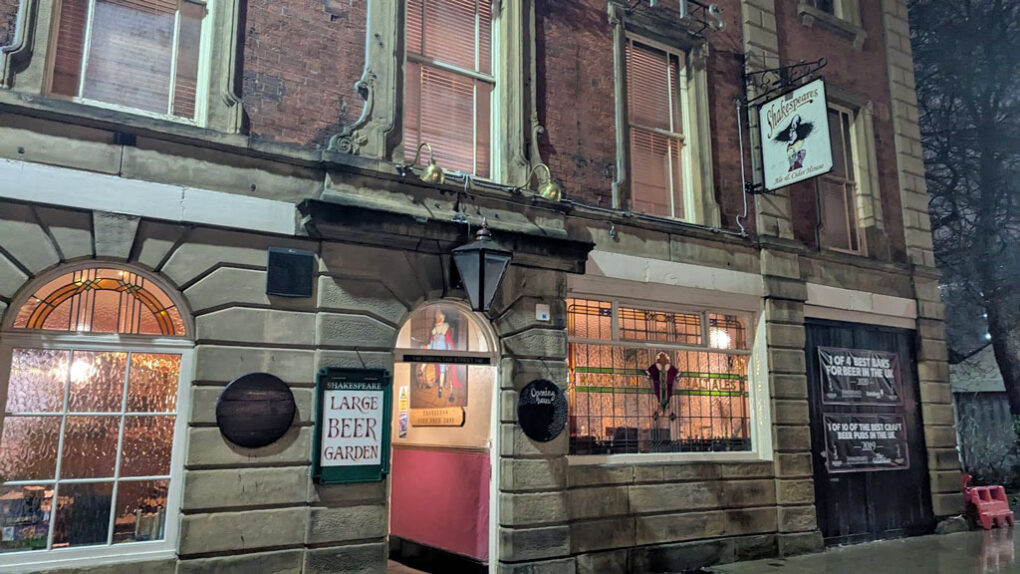
Shakespeare’s is one of the city’s oldest and most cherished traditional pubs. Established in the 1830s, it has retained much of its original Georgian character, offering a unique and atmospheric setting for patrons. In 2010, the pub faced closure due to its owners, Punch Taverns, ceasing operations. The pub was rescued by Real Ale & Music fan William Wagstaff, of The New Beehive Inn in Bradford and extensively refurbished and restored to its former glory as a Georgian Coaching Inn and reopened in July 2011, just in time for the Tramlines Music Festival.
In the first six months after reopening the doors the pub had served over 300 different real ales from near and far, always featuring LocAle on the bar from Sheffield’s excellent breweries as well as new and rare beers from across the UK. In February 2024, Shakespeare’s was honored with the Campaign for Real Ale (CAMRA) Sheffield branch’s “Pub of the Month” award, recognizing its commitment to quality and community engagement.
Note the cobbles in the beer garden! This pub is on the CAMRA Local Inventory of Historic Pub Interiors.