


2 Miles
The history of Manchester is amazing and this walk will take you so some of the most historic pubs that Manchester offers along with a bit of history of the areas you will walk through.
You can download the route here – https://www.bar-trek.com/crawl/721
1. Grey Horse Inn
80 Portland St, Manchester M1 4QX
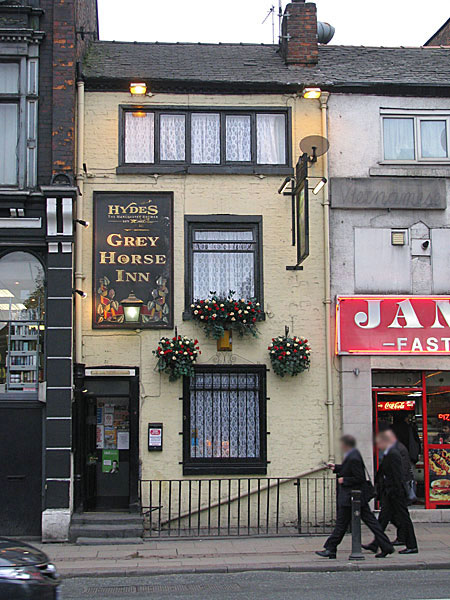
Our starting point is this small pub which was converted from weavers cottages and started selling beer from 1851. It is a friendly single room pub, originally 2 rooms, with a small yard for those who smoke. It has bench seating and has a light and airy feel. This traditional alehouse sits in a row of Grade II listed former town houses, probably late 18th century in date. The upper storeys retain their garret windows, which suggests that the top floor once housed weavers’ workshops. The pub’s name, along with that of the nearby Circus Tavern and Old Monkey, is thought to refer to a travelling circus that spent the winter here in times gone by.
In the post-Cold War period it is rumoured that the pub has been a meeting place for Russian and British spies, which adds to the intrigue of this already popular public house. Like its neighbour, The Circus it vies for the title of one of the smallest pubs in the city.
Exit the pub and look left, in the distance you can see the impressive Britannia House. This was originally Watts Warehouse (1851), the largest warehouse in the City Centre. Each floor is built in a different architectural style, none of which are Gothic or Classical but “a licentious bit of confectionery in stone, iron, timber and glass”.
Turn right when exiting the pub and head down Portland Street and as you turn right, there is a small nondescript door (No. 82), this is the Colin Jellicoe Gallery and it is something of a Manchester institution and one of the least pretentious art galleries you’ll ever find. Manchester-born Jellicoe has exhibited his and other artists’ works here for over 40 years. Colin passed away in 2018 aged 75 but his legacy still remains.
Our next stop is close by.
2. The Circus Tavern
86 Portland St, Manchester M1 4GX

It is reputed to be the smallest pub in the city or even Europe. The building dates from about 1790, and it is thought to be one of the oldest pubs in Manchester, although it only became a pub in about 1840. Opening hours can be varied and though it says it is owned by Tetley’s, that isn’t exactly true as Carlsberg now brew the beer in Wolverhampton. I would advise getting here at opening time to avoid the tourist crowds. The interior is wonderful and needs to be seen when it is not busy.
Exit and look directly opposite, you will see the Pickles Building of 1870 which is typical of the Victorian former warehouses that characterise this part of Manchester. As you walk down Portland Street at the main junction with Oxford Street on your left is the Portland Building. It was built in 1860 for the Louis Behrens and Son company. The building is four storeys high but has 23 bays on the Portland Street side.
On the other side on the right the building with the impressive 8 chimney facade is Oxford Court. It was previously called Princes Building and all that remains of this warehouse complex is the facade. Go across the junction and down Chepstow Street. As the road turns very slightly left, keep to the righthand pavement and just past the modern office block is a small walkway. Turn right down here to our next pub.
3. The Peveril of the Peak
127 Great Bridgewater St, Manchester M1 5JQ

The ‘Pev’ is a famous Manchester institution, still run by the city’s longest serving landlady with 51 years service in 2022. A splendid etched mirror hangs over the fireplace in the snug (formerly the Smoke Room), commemorating the first forty years of her tenure. The pub, like its landlady, is a great survivor. It stands as a small triangular island of civilised drinking, shorn of the rest of the original terrace but surrounded by much taller office and apartment blocks of both 19th and 21st century origin.
The glorious green tiled exterior hides an even more splendid interior, full of polished wood, stained glass and traditional bench seating along the walls – much of it with the original bell pushes that once summoned bar staff to take customers’ orders. There are four distinct drinking areas. Entering from the street you find yourself in a long and twisting drinking lobby surrounding the island bar. Behind the bar, in the V of the pub’s wedge shape, is the public bar, featuring an unusual and antique “table football” machine. In the opposite direction are another wedge-shaped room (the afore-mentioned cosy snug, often the venue for folk groups) and the L-shaped rear room.
Exit the pub and turn right down Great Bridgewater Street to our next pub.
4. The Britons Protection
50 Great Bridgewater St, Manchester M1 5LE

This Grade II-listed 200-year-old multi-roomed pub is listed on CAMRA’s National Inventory of Historic Pub Interiors and famous for its highly ornate interior: a terrazzo-tiled corridor floor, moulded ceiling, original 1930s urinals and the serving hatch through which people in the two rear rooms are served beer from the front bar. Along with many features of the pub, the bar counter, back bar and the bar’s fixed seating dates from the 1930s when the pub was extensively refurbished. The moulded ceiling picked out in red and gold is another feature.
A tiled passageway from the left end of the public bar leads round to the rear of the servery where there are two further rooms, both equally steeped in history. These two rooms are served via a hatchway through to the bar, complete with leaded screens. One of the city’s oldest pubs, It is one of three surviving city centre buildings to have stood near the site of the Peterloo Massacre and is said to have served as a refuge for the injured. It was also used as an army recruitment centre during the Napoleonic Wars.
Now head straight across the junction to the structure that is called the Tower of Light. This 40-metre tall tower supports the enclosed flues for the new low-carbon energy centre in Manchester’s city centre.
On your right is the Bridgewater Hall, home to the 165-year-old Hallé Orchestra as well as the BBC Philharmonic. The building sits on a bed of 280 springs intended to insulate it from external sound and is reputed to be the quietest building in the UK.
On you left is the Manchester Central Convention Complex, it looks like an old station, which it is. This is the old Manchester Central Station and has a distinctive arched roof with a span of 64 metres (210 ft) – the second-largest railway station roof span in the United Kingdom after the Barlow Train Shed at London St Pancras. Straight ahead is the famous Midland Hotel, opened in 1903, it was built by the Midland Railway to serve the Manchester Central railway station, its northern terminus for its rail services to London St Pancras.
At the large paved area next to the Bridgewater Hall, head down the steps to our next venue.
5. Society
100 Barbirolli Square, Manchester M2 3BD

This is the taproom for Vocation Brewery and it is a good place for lunch. The pub is in a shared kitchen and dining area called Society. There are five vendors selling street food available. On the bar, you’ll find four hand pumps and a row of keg taps with 30 more behind the bar.
Opposite is the Bridgwater Canal Basin, part of the Bridgewater Canal to transport coal from Worsley to Manchester. The Bridgewater Canal is described as the first great achievement of the canal age, although the Sankey Canal opened earlier. Bridgewater captured the public imagination because of its engineering feats; it required the construction of an aqueduct to cross the River Irwell, and a tunnel at Worsley. Its success helped inspire a period of intense canal building in Britain, known as Canal Mania. It later faced intense competition from the Liverpool and Manchester Railway and the Macclesfield Canal. Navigable throughout its history, it is one of the few canals in Britain not to have been nationalised, and remains privately owned. Pleasure craft now use the canal which forms part of the Cheshire Ring network of canals.
Now walk back up the steps and across the tram tracks and there is a memorial to the Peterloo massacre here.
On the 16th of August 1819 the huge open area around what’s now St Peter’s Square, Manchester, played host to an outrage against over 60,000 peaceful pro-democracy and anti-poverty protesters.An estimated 18 people, including four women and a child, died from sabre cuts and trampling. Nearly 700 men, women and children received extremely serious injuries. All in the name of liberty and freedom from poverty. The Massacre occurred during a period of immense political tension and mass protests. Fewer than 2% of the population had the vote, and hunger was rife with the disastrous corn laws making bread unaffordable.
As 600 Hussars, several hundred infantrymen; an artillery unit with two six-pounder guns, 400 men of the Cheshire cavalry and 400 special constables waited in reserve, the local Yeomanry were given the task of arresting the speakers. The Yeomanry, led by Captain Hugh Birley and Major Thomas Trafford, were essentially a paramilitary force drawn from the ranks of the local mill and shop owners. On horseback, armed with sabres and clubs, many were familiar with, and had old scores to settle with, the leading protesters.
By 2pm the carnage was over, and the field left full of abandoned banners and dead bodies. Journalists present at the event were arrested, others who went on to report the event were subsequently jailed. The businessman John Edward Taylor went on to help set up the Guardian newspaper as a reaction to what he’d seen. The speakers and organizers were put on trial, at first under the charge of High treason – a charge that was reluctantly dropped by the prosecution. The Hussars and Magistrates received a message of congratulations from the Prince Regent, and were cleared of any wrong-doing by the official inquiry. Historians acknowledge that Peterloo was hugely influential in ordinary people winning the right to vote, led to the rise of the Chartist Movement from which grew the Trade Unions, and also resulted in the establishment of the Manchester Guardian newspaper.
Follow the road in front of the exhibition centre and continue down Windmill Street to the end where it joins up with Watson Street. Turn right then left down Peter Street and again right down Jerusalem Place. Then right down Bootle Street to our next pub.
6. Sir Ralph Abercromby
35 Bootle St, Manchester M2 5GU

This is a traditional back street local, located next door to the city’s main police station named after Lieutenant-General Sir Ralph Abercromby. It is thought to be the inspiration for the pub in the Life on Mars TV series. It was under threat of demolition from 2014 to 2017 due to a new development but was saved after a determined battle by friends of the pub assisted by CAMRA. It is close to the site of the Peterloo massacre and is believed to be the only pub remaining from that period. A mural has been painted commemorating the massacre and adorns one of the walls.
Exit the building and turn left to the end, turning left down Southmill Street. Keep walking into Lloyd Street and Albert Square. This square was laid out in 1863-67 and on one side sits the impressive Manchester Town Hall.
Take a look at the Albert Memorial, notice how similar it looks to the one in Kensington Gardens, London, which was completed some seven years after the Mancunian monument. Claims that Worthington’s design influenced George Gilbert Scott in his London monument are disputed. Scott, writing in his Recollections, stated that his idea of building a medieval canopy was original, “so new as to provoke much opposition”. Cross over the junction with John Dalton Street and Princess Street up Cross Street to our next port of call.
7. Mr Thomas Chop House
52 Cross St, Manchester M2 7AR

Mr Thomas’s is one of only a handful of Manchester pubs listed in CAMRA’s National Inventory Of Historic Pub Interiors. Opened in 1867 by Thomas & Sarah Studd, brother to Samuel Studd of Sam’s Chop House. They are famous for their Corned Beef Hash and perhaps Manchester’s prettiest beer garden. A long, narrow room divided by green tiled arches leads from the entrance along the bar and opens up into two further rooms divided by the same arches at the back. The rear room is a dining area and there is a magnificent ceramic fire place. Handpulls in both front and back room. It was renamed as Mrs Sarah’s Chop House in March 2019 in honor of the mother and daughter who ran it over 100 years ago.
Exit the Chop house turning left up Cross Street. Pass the Royal Exchange Theatre which was the old cotton exchange. However, it was heavily damaged during the Manchester Blitz and in the 1996 Manchester Bombing. It is now a theatre and arts complex as well as a beautiful underground walkway, The Royal Exchange Arcade which is worth a visit. Where the Royal Exchange building ends, turn left into Market Street. Shortly, turn right into New Cathedral Street to the end at Shambles Square and our next stop.
The map shows a different route and either is fine.
8. The Old Wellington
4 Cathedral Gates, Greater, Manchester M3 1SW

This pub dates back to 1552 when it was close to the old market which was the centre of the town at that time. It is the only remaining timber framed building typical of Manchester at that time. Despite its age it has been fairly mobile in recent times. Along with Sinclairs Oyster Bar it was raised on a concrete raft in a 1970’s redevelopment of the old Shambles to make way for an underground access road. Both pubs moved again after the IRA bombing of 1996, this time about 120yards to their current location and reopened in 1999 with the Old Wellington being turned through 90 degrees.
There is a great video clip of these two buildings during the move.
Leaving the pub, walk past Sinclairs Oyster Bar turning left following the buildings on Exchange Square.
This square was created after the 1996 bombing by the IRA, the main building on your left is another corn and produce exchange. This just goes to show how large the volume of trade was prior to the late 19th Century, with numerous buildings in Manchester dedicated to trading in produce.
Shortly turn right up Withy Grove passing the Printworks building on your left. This building was the HQ for newspaper proprietor Edward Hulton in 1873 who was one of the first people to print a newspaper dedicated to sport, The Sporting Chronicle. The site housed a printing press until 1988 when Robert Maxwell bought the property and subsequently closed it down.
Turn right down Shudehill and follow the road across the tram tracks turning right again into Swan Street. Our final stop is beckoning.
9. The Crown and Kettle
2 Oldham Rd, Ancoats, Manchester M4 5FE

The pub was originally opened around 1800 in a Gothic style with traceried windows and was previously known as the ‘Iron Dish & Cob of Coal’. There are records of a building being in this location since as early as 1734, with it at one time serving as a courthouse. The mahogany panelling originally installed within the small snug is claimed to have been sourced from one of a pair of British rigid airships, R100 or R101. In 1989, the pub was closed by Manchester City Council following a fire which damaged half of the interior started following a large fight between United and City supporters.
It reopened in 2005 following restoration work with Historic England, including to the plaster ceiling which was restored in one bar and left in an unrestored state in the other.
