


3 Miles
Rather than have a start point, I thought it would be better to start at our first pub. Many thanks to Rachael Unsworth of Leeds City Tours for her input and fact checking.
Click here to book one of her fantastic and informative tours of Leeds.
You can download the beer walk here – https://www.bar-trek.com/crawl/718
1. Editors Draft
88 Wellington St, Leeds LS1 4LT
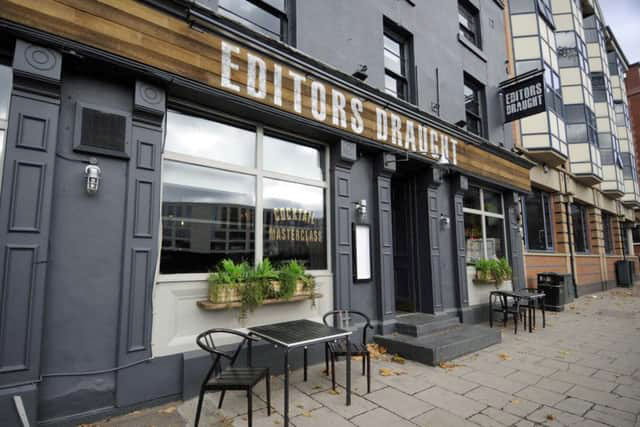
The pub has had quite a few different names in the past and was the birthplace of Leeds CAMRA, the Campaign for Real Ale. It’s been the Wellington and Scruffy Murphy’s and the Phoenix, and at least twice has reverted to its historic name of The Central. The latter is a contraction of the Central Station Hotel, though a grimy brick goods hoist is all that remains to remind us that Leeds Central Station once existed just across the road, before rail traffic was concentrated into the newly-built City station in the 1960s.
Leeds Central Station was part of the London and North Western Railway which is now known as the West Coast Main Line. All the new development opposite is on the site of this once large terminus. The last train left this station in 1967 when all train services were rerouted to the new Leeds City Station. The building next door to the pub at the junction with Britannia Street was the HQ of James Hare Limited, a cloth manufacturer. In the 1910’s, they were the biggest stockist of Harris Tweed in the world and became known as the “Cloth Headquarters of the British Isles”, and was the largest textile distribution house in Great Britain.

© National Library of Scotland

© National Library of Scotland
Exit the pub and turn up Little Queen Street the right down St Paul’s Street. Shortly, turn left into Park Square West. Here you will encounter a wonderful park square surrounded by Georgian buildings. The square is a traditional Georgian park and was developed at the end of the 18th Century for the upwardly mobile wealthy, to give them some distance from industry and the river, but within easy reach of the commercial centre. In naming the area, the word ‘street’ was avoided in favour of terms such as ‘Row’, ‘Parade’, ‘Place’ and ‘Square’, considered more prestigious, as had already been done in Georgian developments such as Bath, Bloomsbury and Bristol.
However the initial aim of a purely residential area was not maintained when a large warehouse and cloth cutting works, St Paul’s House, was built in 1878 for ready-made mass production tailor John Barran on St Paul’s Street, with its rear aspect effectively taking up half the south side of the square. This was, however, in grand Arabic-Saracenic style by architect Thomas Ambler, and notable as the first planned and designed clothing factory.
There are some famous residents associated with the square and they are:
- Pioneering surgeon Berkeley Moynihan had his consultancy rooms on the square. He introduced the needs for rubber gloves during surgery to prevent infection and showed that caressing the tissue during surgery was better than speed.
- Sir Clifford Allbutt, inventor of the clinical thermometer had his consulting rooms at number 35.
- After marrying in 1808, brewer Joshua Tetley settled in Park Square.
- Edith Pechey, one of the first women doctors in the United Kingdom and a campaigner for women’s rights, opened her own practice at number 8, Park Square.
Keep walking along Park Square West to the north west corner of the square and turn right down Westgate to our next stop.
2. Town Hall Tavern
17 Westgate, Leeds LS1 2RA

Small traditional inter-war brick-built pub which dates from 1926 and is opposite the law courts on Westgate near the Town Hall and Leeds Central Library. The pub consists of a single room with open alcoves to the left and right of the door. Along the left hand wall is the bar with its range of Timothy Taylor beers on six handpumps.
Opposite, you can see the old Leeds Methodist Chapel of the 1830’s, with a late 19th Century extension wrapped around the south and east sides.
Exit the pub and turn right down Westgate then quickly left up Oxford Place passing the old Leeds Methodist Building. On your right is the Grade I Leeds Town Hall. It was imagined as a municipal palace to demonstrate the power and success of Victorian Leeds, and opened by Queen Victoria in a lavish ceremony in 1858, it is one of the largest town halls in the United Kingdom. With a height of 225 feet (68.6 m) it was the tallest building in Leeds for 108 years from 1858 until 1966, when it lost the title to the Park Plaza Hotel, which stands 26 feet (8 m) taller at 253 feet (77 m). The distinctive baroque clock tower, which serves as a landmark and a symbol of Leeds, was not part of the initial design but was added by the architect Cuthbert Brodrick in 1856 as the civic leaders sought to make an even grander statement.
It was used as a model for civic buildings across the country as well as overseas, being one of the largest and earliest. Take a guided tour around this magnificent building another day, it will be worth it but you will have to wait until 2026. At the end of Oxford Place turn right into Great George Street and our next venue.
3. Victoria Family & Commercial Hotel
28 Great George St, Leeds LS1 3DL

Unfortunately, this place is currently closed but is due to reopen in late 2024. It is part of the heritage of Leeds which is why we have made the detour. The upper floors are being converted into student accommodation but the pub is to remain and reopen under a partnership between Kirkstall Brewery and Whitelock’s Ale House. It was built in 1865 to serve people attending the Assize Courts newly held at Leeds Town Hall. Its stylish accommodation then comprised spacious dining rooms and bars, a billiard room and large meeting room, private sitting rooms and 28 bedrooms.
Assize courts were a fundamental part of the criminal court system in England and Wales, along with the courts of quarter sessions. They were responsible for hearing cases involving serious offenses, such as murder, rape, and highway robbery. They also heard civil cases, often related to land or money. The Courts Act 1971 abolished the assizes and replaced them with a single permanent Crown Court. Below is a picture of the inside and hopefully it will be kept for future patrons to enjoy the spender of this place.

© CAMRA
Now continue along Great George Street and on your left is a building called ‘The Electric Press’, this is now a multi-restaurant venue but it was initially a printing works called Chorley and Pickersgill. Alongside the print works, the building once housed West Riding Carriageworks and cabinet manufacturers Roodhouse & Sons. It was named after a brand new American electric printing press was installed in 1899, only 5 years after the start of electricity supply in Leeds city centre by the Yorkshire House to House Electricity Company from its power station in Whitehall Road.
A bit further along we reach Leeds Cathedral on our right. Leeds obtained cathedral status for the earlier Catholic church in 1878 but this building is relatively new. The original Cathedral was at the junction of Guildford Street (the present Headrow) and Cookridge Street but the Leeds Corporation decreed that more space was needed for trams to turn the corner at the end of 1899 it was formally announced that it was to be compulsorily purchased and demolished. Several alternative sites for its replacement were considered but it was decided to accept the Corporations offer of land just yards from the existing church, at the junction of Cookridge Street and Great George Street.
Construction of the present Cathedral began in the autumn of 1901 and was completed in the early part of 1904. The task of designing Leeds new Cathedral was given to a London architect, John Henry Eastwood (1843-1913), who had been born near Leeds. He in turn engaged the services of a talented assistant, Sydney Kyffin Greenslade (1866-1955). Together they produced an outstanding design in the Arts and Crafts neo-Gothic style with an unusual layout to accommodate the Cathedrals relatively small city centre site.
Continue walking into Merrion Street then at the end turn right onto Vicar Lane and our next stop.
4. The Templar Hotel
Templar St, Leeds LS2 7NU

This is an historic public house and is Grade-II listed due to its many original 19th and 20th century external and interior features. The ground floor is clad with distinctive green and cream Burmantofts faience tiling with stained glass windows (featuring an abstract art deco version of the Melbourne Brewery bowing courtier), wood panelling, fixed seating, the fireplace and the bar. It has been described as a traditional and largely unspoilt pub. Internally, the fixtures and decorations dating from 1928 have been well-preserved.
When you exit the building, cross over the road into the Grand Arcade, built in 1897. Look out for the animated clock. Sadly the imperial characters who used to mark every hour by marching across the front no longer move. Exit the Grand Arcade onto Briggate and turn left passing the Grand Theatre & Opera House which opened on 18 November 1878. It was built as a complex in three parts: the theatre, a set of six shops and Assembly Rooms, all facing onto New Briggate. In 1907, the assembly rooms were converted into a cinema and in 1970 it was bought by Leeds City Council but the cinema closed in 1985 and it became the home of Opera North in 1978.
Click here to read more about it from Peter Brears (The Georgian Group).
Keep walking down New Briggate to our next venue.
5. North Bar
24 New Briggate, Leeds LS1 6NU

This place opened back in 1997 and was a pioneer in the small bar movement. The cask ales on the bar are joined by a range of keg offerings with a wide variety of styles and ABVs, many from North Brewery, located just a mile and a half to the north of here.
Now keep heading down Briggate. The name translates as ‘The Street to the Bridge”. Brig is a modern spelling of the old word, brycg and gate derives from the Scandinavian word for street, ‘gata’. The street has been in existence since 1207. We will be following this street for a while. However, our next stop is close by and it is found next to the Queens Arcade on your right through a small archway.
6. The Ship
Queens Arcade, 71 Briggate, Leeds LS1 6LH

This is a long narrow pub with a single room on two levels with the bar next to the main door. It has brass fittings, period lighting and an impressive wall clock. Not much is known about this little pub but it is reckoned to have existed since the 1750’s. Then in Georgian times, it was once one of the haunts of actors, musicians and other people connected with the theatre due to the close proximity of the City Varieties, the Grand Theatre, and the now demolished Empire and Theatre Royal. It is also perhaps the smallest of the three we are going to visit in short succession.
The pub stands on what was a burgage plot. Created in 1207 by Lord of the manor, Maurice Paynell, Briggate became the first borough of Leeds, with 30 burgage plots laid out along each side of the street where the burgesses (tenants) paid 16 pence a year in rent. A burgage plot was for tradespeople to carry out their business. A plot was a strip with a length of between 10 and 18 perches and a width of 3 perches, i.e. 49 ft 6 in (15.09 m) in width running east or west from the road. This spacing can still be seen on many of the shop frontages and the buildings behind. The burgesses were also allocated half-acre agricultural plots in Burmantofts (burgage men’s tofts).
Now exit continuing up the small alleyway to Lands Lane, turn left and quickly left again down Angel Inn Yard to our next stop. The map might show you continuing down Briggate but ignore it and following the instructions above.
7. The Angel Inn
Angel Inn Yd, Leeds LS1 6LN

This is a busy Sam Smith’s pub and the only one that serves their beer on cask. It is contained within a Grade II listed historic building turned public house, constructed in the mid-18th century. This means that the Angel Inn is likely to be the oldest purpose-built inn building within the yards off Briggate. As a three-storey structure it is also likely that Angel Inn stood taller than the street shops, with access provided from both Briggate and Lands Lane.
Now exit back to Briggate, turn right and a little further down on your left you can see our next stop.
8. The Pack Horse Inn
Packhorse Yard, Leeds LS1 6AT

The Pack Horse pub in Leeds, England has a rich history, including its origins as a farmhouse and its location in Pack Horse Yard, the former home of Joseph Aspdin, the inventor of Portland cement in 1824. As you enter the yard, look up and you will see a marker of its rich history, an iron Templar Cross, that’s still nailed to the gable end of the pub. It’s one of only two left in the whole of England. This shows it was originally owned by the Order of St John of Jerusalem, successors to the Knights Templar. This is believed this carried certain privileges for establishments which displayed them, including the ‘Leeds Soke’, an exemption from having to use the King’s Mill in Swinegate to grind corn.
A pub on the site of The Pack Horse first opened in 1615 as The Nag’s Head, although there may have been a drinking house on the site since the 1130s. In 1780 it changed its name to The Slip Inn and was a favourite of the loiners of Leeds. In 1982 it was renovated following the discovery of 15th Century elements of the original building and became The Pack Horse we know today.
Now exit the same way you came in back to Briggate. Turn right to our next venue which is down a small alleyway on your right.
9. Whitelock’s Ale House
Turk’s Head Yard, Leeds LS1 6HB

Described by John Betjeman as “the Leeds equivalent of Fleet Street’s Old Cheshire Cheese and far less self-conscious, and does a roaring trade. It is the very heart of Leeds.” It first opened in 1715 as the Turk’s Head, a heritage reflected in the name of the yard in which Whitelock’s is situated – it is still called Turk’s Head Yard. In 1867 the licence of the Turk’s Head was granted to John Lupton Whitelock. In the 1880s the Whitelock family purchased the pub, and in 1886 refurbished the pub, establishing the ornate decor still in place today, including the long marble and copper topped bar, tiled front, etched brewery mirrors and cast iron fireplace.
From the mid-1890s the pub became known as Whitelock’s First City Luncheon Bar and in 1897 John Lupton Whitelock installed electricity, including a revolving searchlight, at the Briggate entrance to the yard. Whitelock’s was reportedly the first building in Leeds to have electric lighting and an electric clock. Whitelock’s was a favourite rendezvous with stage stars and it received royal approval when Prince George, later Duke of Kent, entertained a party in a curtained-off section of the restaurant. At one time a doorman made sure that men wore dinner jackets and, as women were not allowed at the bar, waiters served drinks where female customers sat. If you want to you can pop your head into the Turks Head which has a different vibe.
Exit the same way you came in and back to Briggate but turn left and then right into Kirkgate. Kirk is old Norse for Church (Kyrka) and we know that gate (gata) means street, so Kirkgate is Church Street. It is considered to be the oldest street in Leeds. Keep walking until you reach New Market Street and opposite you can see Leeds Kirkgate Market which we shall pop into (It closes at 5pm and on Sundays).
So, enter through the main door opposite you and into a slice of history. When the market opened in 1857, it was the largest indoor market in Europe. It was designed by the celebrated architect Joseph Paxton, who was responsible for both the Crystal Palace in London as well Crystal Palace Park in South London. It pushed technological as well as architectural boundaries by creating ‘fish row’ an innovative cooled area for fishmongers bringing fresh produce from the coast in 1895. The characteristic domed and glazed roof was also added to protect shoppers from the weather around the same time.
As the entrance building was under construction the market witnessed the birth of a retail institution. Lithuanian Michael Marks set up a stall called the Penny Bazaar, with the slogan – “Don’t ask the price, it’s a penny”, which proved wildly popular. Later he took on a partner, Tom Spencer. Together the business minded duo opened a string of shops, Marks and Spencer was born and rest is history. It is not know precisely where the stall was but there is a reproduction so see if you can find it and the central clock tower.
Exit the market and head to New York Street. This is nothing to do with New York in the USA but when the west end of York Street was renamed to accommodate a new block of buildings.Depending on where you exited the market, turn left back to Kirkgate and you need to find Call Lane. Which has been in existence since 1557 and it joins up with The Calls.
There are some quirks to the street names in Leeds and they are:
- The Calls (Call Lane) – Seems to originate from the livestock that were in the vicinity, in this case Cows. Other locations are easier to determine such as Boar Lane or Swinegate.
- Why does East Parade run almost South to North at the West end of South Parade which runs roughly West to East (Park Row) almost at the North end of both?
Now we reach the Corn Exchange and take a walk inside. The Corn Exchange was opened in 1863 and is now a Grade-I listed building. It replaced an earlier building on the same site. Built by the same architect as Leeds Town Hall, Cuthbert Brodrick. The amazing dome was based on the Bourse de Commerce, Paris. It is now one of only three remaining Corn Exchanges still functioning as a centre for trade in Britain.
Exit the Corn Exchange and look left to our next stop.
10. White Cloth Hall
27 Crown St, Leeds LS2 7DA

Constructed in 1711, it is the first of four halls built over the last three centuries for the sale of undyed cloth, and only one of two that still remain in Leeds. It was built to dissuade traders from moving away to a new covered cloth hall in Wakefield. The building was sliced in half by the mid-Victorian railway viaduct and due to its state of disrepair, parts of the building were demolished in 2010. Then in 2018, Leeds City Council gave the go ahead to restore the building. The original oak timber trusses, which play a significant part in the building’s heritage, were salvaged in the renovation and incorporated into the roof structure of the new build. What we see now is only a fragment of the vast building and inside you will find a bar with centralised seating and a collection of small food outlets.
When you leave White Cloth Hall, head straight keeping the Corn Exchange on your right and into Duncan Street.
At the junction with Boar Lane, turn left down Briggate and look to your right and the fabulous building with the clock faces. The building’s appearance dates mainly from the late 19th century. Previously on this site were a variety of businesses in smaller premises such as a distillery, saddlery, barber and perfumier and stationer. By 1870, a watchmaker by the name of John Dyson occupied No. 26. By 1882 he occupied 24 and 25 as well. The distinctive features of the building are the gilded time ball, and the cantilevered clock, surmounted by a figure of Father Time carved by John Wormald Appleyard. A second clock by Potts of Leeds was installed in 1910.
Perhaps inspired by the model of the time ball at Greenwich installed in 1875 by Potts of Leeds in their shop window in Guildford Street, the gilded time ball mechanism was installed in 1877. It had a connection to the time equipment at Greenwich and the time ball dropped at exactly 1 pm each day. On your left is our stop.
11. Bowers Tap
157 – 158 Lower Briggate, Leeds LS1 6BG

The pub sits in a building constructed in 1894. There was a shop here called Watson Cairns which sold bicycles. The current landlords have put the building up for sale with a £1.3 million price tag. Let’s hope that it continues as a pub because it won best brunch menu 2023.
Exit turning left and continue down Briggate passing Westrow House. This was a former coaching inn built in 1862 called the New King’s Arms and had stables for 18 horses. It was renamed The Royal Hotel in 1834, and much later was converted into flats in the late 1970s. It then lay derelict for a while and in 2013 this became the home of the Westrow Academy, a hairdressing school.
Continue onwards and at the junction with Commercial Court on your left is a small iron gate leading into a passageway called Queens Court. If it is open then walk down it to see a wonderful piece of Leeds history. The building was formerly a wealthy cloth merchant’s premises, named after Queen Anne and dates from 1714. This was a time when wool was a key part of Leeds’ prosperity. It is best seen from the other side of the road. The yard itself housed a warehouse as well as finishing shops. You can still see the old entrances and imagine a time gone by when this place was busy.
Now walk under the railway bridge and on you left was the Old George Hotel, Charlotte Brontë stayed here while traveling to Belgium. She later described the pub’s interior in her 1847 novel Jane Eyre.

© Leeds City Council
The Old George Hotel, which was once under the railway bridge on Lower Briggate, is believed to have been first owned by the Knights Templar in the 13th century. The much later photo, taken in around 1891, still shows the Templar crosses displayed on the front of the pub. The hotel closed in 1919 and was demolished soon after and what you see now is a modern replacement.
Continue down Briggate and across Swinegate towards the river Aire and Leeds Bridge.
This is the oldest crossing of the river and although the metal bridge dates from the early 1870s, people were crossing here even before the Medieval stone bridge was built. In 1888 the bridge was witness to a world first. The “Father of Cinematography”, Louis Le Prince, shot what is considered to be the world’s earliest moving pictures from the bridge. He was possibly the first person to shoot a moving picture sequence using a single lens camera and a strip of (paper) film, 8 years before the famous Lumiere film of a train at La Ciotat station in France. But Le Prince never took his rightful place in film history because he mysteriously vanished before he could screen that film in New York in 1890 as he planned. But curiously, a few months after Le Prince disappeared, Thomas Edison announced that he’d invented a motion picture camera in 1891.
Edison probably invented the process of using celluloid film instead of paper, which meant you could project a light through the film to show the image on a large screen. I’ll let you decide who was first?
Another important piece of history was the death of David Oluwale in 1969. The events leading to his drowning have been described as “the physical and psychological destruction of a homeless Black man, whose brutal and systematic harassment was orchestrated by the Leeds City Police Force.” Oluwale’s death led to the first successful prosecution of British police officers for their involvement in the death of a Black person. The legacy of his life, experiences, and death has shaped discussions on systemic racism within British legal institutions, police brutality and practices, inequality, and mental health policy. As you walk across this famous bridge, take a look on your left at two plaques. One for Louis Le Prince and the other about the ‘Band of Hope’.
In 1847, a 72-year-old Irish Presbyterian lady was invited to Leeds to speak at a series of children’s meetings. Ann Jane Carlile was convinced that children suffered because of the ready availability of ‘strong drink’. Ann met a young Baptist minister called Jabez Tunnicliffe, who had been shaken to the core by his experience of a dying alcoholic. Just before he died, the man had clutched at Tunnicliffe and made him promise to warn children about the dangers of drink. Ann and Jabez decided to start a regular children’s meeting (a Band of Hope) in Leeds. It isn’t clear who thought of the name, but Ann is supposed to have said, “What a happy band these children make, they are the hope for the future.” The idea for regular children’s meetings spread and in 1855 The United Kingdom Band of Hope Union formed to support the local groups. This is all part of the Temperance Movement which I will mention later on.
Take your time to look at some of the other monuments and plaques located on the bridge before moving on. Continue across the bridge and as the road swings slightly right we reach our next destination.
12. The Adelphi
1-3 Hunslet Rd, Leeds LS10 1JQ

This has a remarkable Victorian exterior and interior and is on CAMRA’s National Inventory of Historic Pub Interiors. Built 1901 in the majestic style of a late Victorian ‘drinking palace’ (of which few were ever built in Yorkshire), the Adelphi was designed by Leeds architect Thomas Winn for the local Melbourne Brewery. Its highly ornate, multi-roomed interior was carefully looked after for many years by Melbourne’s powerful successor, Joshua Tetley & Son, and it has survived wonderfully well to this day (although the effect has been superficially diminished of late by some ‘cafe-bar’ décor). Four rooms radiate from the central corridor including the Tap Room to the very rear. The classic West Yorkshire corridor bar is still in use.
When you exit the pub, look across the road at the building on your left, Leeds Bridge House.
This has an interesting history built in 1881 and opened as Leeds “People’s Café” – a sort of working men’s club of the era with temperance principles (i.e. Alcohol free), providing cheap food as well as accommodation with 30 rooms and baths where people could bathe at affordable prices. It was re-branded 8 years later as The Cobden Temperance Hotel. The Temperance Movement which began in England in the 1830s was popular in many northern towns and in 1897 there were no less than 30 Temperance Hotels listed in a Leeds Directory. But even the high hopes of this takeover were soon dashed because by June 1895 the ground floor had been converted into shops and the upper stories had fallen into disuse and was nearly destroyed when Leeds City Council bought it in 1960 for demolition to build a motorway extension.
The Adelphi Public House was once round the corner in Dock Street. This was at the time of the Theatre in Hunslet Lane and before the creation of Hunslet Road when it was moved to its present location.
Now walk down Hunslet Road and in the distance you will see our next destination. Walk past the Salem Chapel, built in 1791 by the Rev Edward Parsons, Salem is the oldest surviving non-conformist chapel in Leeds city centre. The historic chapel was the birthplace of Leeds United Football Club in 1919. Salem’s hall was the venue for a public meeting in which Leeds City F.C. was disbanded over financial misdemeanours, and Leeds United F.C. was formed. The chapel was closed as a place of worship in 2001. The psychologist and writer Reverend Harry Guntrip preached the last sermon. It now serves as a data centre for the north of England.
13. The Tetley
The Tetley, Hunslet Rd, Leeds LS10 1JQ

This building reopened in 2024 by the Kirkstall Brewery. This is the former headquarters of Joshua Tetley & Son, at one time the largest producer of cask beer in the world. The site covered over 21 acres or 8 hectares and below is a map showing the site as well as an aerial image from 1947.

© National Library of Scotland

You can either finish here or continue to our next destination.
Exit and walk straight across alongside the Salem Chapel down Salem Place to reach a piece of street art called ‘Hibiscus Rising’. Created by artist Yinka Shonibare and commissioned by The David Oluwale Memorial Association (DOMA), is a poignant 2023 tribute to British Nigerian and Leeds resident David Oluwale.
Turn left along Meadow Lane then right down Great Wilson Street. ASDA’s HQ is on your right. Follow the A653 Victoria Road round to the left and shortly you should see our next stop.
14. The Grove Inn
Back Row, Holbeck, Leeds LS11 5PL

Established in 1832, The Grove was re-modelled in 1928-29 by its then owners John Smith’s of Tadcaster. It is a traditional four room corridor pub which retains features of historic interest. There is a large concert room at the rear which has been a key feature of Leeds’ live music scene for decades. Iconic musician Mark Knopfler of Dire Straits performed at the pub and formed his later band, The Notting Hillbillies, in the back room. The pub also hosts the UK’s longest running folk club, formed in 1962, but I would dispute that since the Topic in Bradford started in 1958. So, perhaps it is the oldest one in Leeds and not the UK.
Now head up Back Row, turning right up Front Street then left down Front Row. At the end turn right down David Street, right down Water Lane and quickly left down Wharf Approach. Follow Wharf Approach and cross over the canal following the road as it track the railway arches which are now underground car parks and soon our next destination appears.
15. The Hop
Arches X & Y Granary Wharf Dark, Neville St, Leeds LS1 4BR

This is the tap room for Ossett beers and it is a live music venue so isn’t really the place to go if you are after a quiet pint. There are 2 corridors of seating which lead to an open plan bar area which has 10 hand pumps! Stairs at either side lead up to a mezzanine floor. The band plays in the middle upstairs so you can see them both if you are sitting upstairs or standing down in the bar.
Turning left follow the path keeping the railway on your left. Follow the signs to the station which means you turn left and walk underneath the railway viaduct. Turn right and follow this road to Neville Street. You will notice that you are crossing over a series of waterways, this is the River Aire which runs under Leeds Railway Station through a network of brick arches known as the Dark Arches. The Meanwood Beck is another river that runs underground through Leeds, including under the bus station and the railway and joins up with the River Aire at Leeds Dock.
At the end turn left to continue underneath the railway following the road and our next stop.
16. The Scarbrough Hotel
Bishopgate St, Leeds LS1 5DY

Named after its first owner, Henry Scarbrough, rather than the seaside town and commonly misspelled. The building first became a pub in 1826 and a beautifully tiled exterior leads to a long bar opposite the entrance with seating areas to either side. The history dates back to when Leeds Manor House stood on the site of ‘Castle Hill’, its deep moat looped between the river and Boar Lane. The building was lavishly rebuilt in 1765 before being taken over by landlord Henry Scarbrough in 1823 when it was named The King’s Arms. The present day pub is a surviving extension and over the years was nicknamed ‘The Taps’ either due to its taproom where people would enjoy tasting sessions or being used for Leeds City Varieties auditions.
The pub has also been visited by a number of famous faces over the decades. These have included writer Charles Dickens, regarded by many as the greatest novelist of the Victorian era, Hungarian composer Franz Liszt, star violinist Henri Vieuxtemps, English composer Lewis Henry Lavenu and The Prince of Wales who went to to become King Edward VII.
Exit and turn left following Bishopsgate Street for a short while, keep to the left and up Mill Hill to our next stop.
17. The Bankers Cat
29 Boar Ln, Leeds LS1 5DA

It was built around the 1870’s and was called the Saracens Head Inn. Then in the 20th Century, it became a bank for most of it’s life before becoming a pub once again in 2019. There is much to admire in the island bar counter, lots of wood panelling and several small seating areas. To the right is a lovely stained-glass window which is an exciting and unexpected touch. There is even a small library. Downstairs additional seating is in the old bank vaults, including in the former safe. The window was not part of the old bank but is a replica of an Edward Burne Jones window at the brewery’s first home, Thornbridge Hall, created specially for the pub.
Here ends our little trip around Leeds. There are plenty more pubs to visit but these are the ones that I think are the best.